Stafford Beer
13 Feb 2022 - 09 Sep 2026
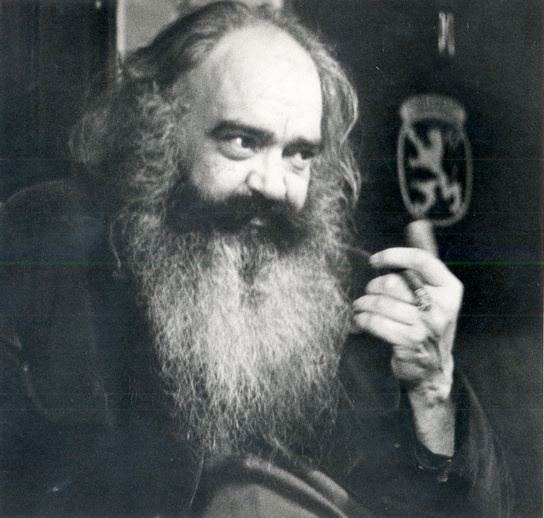
The history of cybernetics is filled with curious characters, and Stafford Beer was not an exception. He wore a long beard for much of his life, habitually smoked cigars, and drank whiskey from a hip flask while discussing scientific ideas late into the night. He included his own poetry and drawings in his scientific publications. Later in his life he gave up many of his material possessions and lived in a small cottage in Wales lacking running water, central heating, and a telephone line. Beer has been described as a “swashbuckling pirate of a man,” a “cross between Orson Welles and Socrates,” and a guru. His writings addressed subjects as diverse as economic development, socialism, management science, terrorism, and even tantric yoga.

- A summary of all of Beers books: Ten Pints of Beer from Cwarel Isaf Institute whose mission is to promote Beer's work.
- 100 Years of Stafford Beer - by Karl Schroeder via jlr
Those ideas still matter because the tools he gave us, such as team syntegrity, can be used by anyone, and are designed to move the locus of decision-making from the top of a pyramidal hierarchy to the edges of a network.
- And what is team syntegrity Ask Claude
- Team Syntegrity is a structured group process Beer invented for non-hierarchical, collective decision-making. Here's how it works:
- The Core Idea
- Beer created Team Syntegrity as a methodology for social interaction that predisposes participants towards shared agreement among varied and sometimes conflicting interests, without compromising the legitimate claims and integrity of those interests.
- It is particularly appropriate when groups are characterized by high levels of diversity — whether from different countries, or from different political, cultural, or disciplinary perspectives.
- The Geometric Structure
- The weird and distinctive part: the whole thing is modeled on an icosahedron (a 20-faced, 30-edged, 12-vertex polyhedron).
- Team Syntegrity builds on Buckminster Fuller's proposition that all systems are polyhedra. Beer proposes a formal model based on the structure of the icosahedron — a convex polyhedron of 30 edges, 20 triangles, and 12 vertices.
- The 30 edges of the model are mapped to 30 participants, and the 12 vertices map to 12 teams.
- Five edges lead to each vertex, so there are five members to each team. Each participant as a player belongs to two different teams — those connected by the edge that represents them.
- A participant will be engaged directly in two teams as a member and two teams as a critic.
- The Process
- Beer applied principles of managerial cybernetics to achieve high levels of "syzygy" (cooperation and commitment) in groups large enough to satisfy issues of requisite variety, and small enough to accomplish something. The result is Syntegration — a collaborative group process for thirty people that takes five days.
- The same problem with its different but interconnected aspects is continually processed by the same set of people gathering in alternating compositions, which provably leads to a self-organizing process with a high effect of integration: via reverberation, information in the group is shared progressively over time.
- The closed communication system enabled by the icosahedron structure allows reverberation to happen, producing logical closure as a consequence of the recurrent interactions of the participants. Beer suggested that reverberation in a closed system results in synergy.
- Why No Hierarchy
- An internal network of interactions is created by a set of Protocols . A group organized like this is an ultimate statement of participatory democracy, since each role is indistinguishable from any other. There is no hierarchy, no top.
- The Name
- "Syntegrity" is a mixture of synergy and tensegrity — the term "synergistic tensegrity" was first coined by B. Freesman.
- In short: it's a facilitation protocol where the geometry of a polyhedron is used to guarantee that every participant cross-pollinates with every other participant through overlapping team memberships, so information and ideas spread throughout the whole group without anyone being in charge.